I could go back to studying for my classes. I could stop the seemingly endless meetings with Yale administrators. And I could save my legal career a future that now seemed in jeopardy.
All I had to do was apologize.
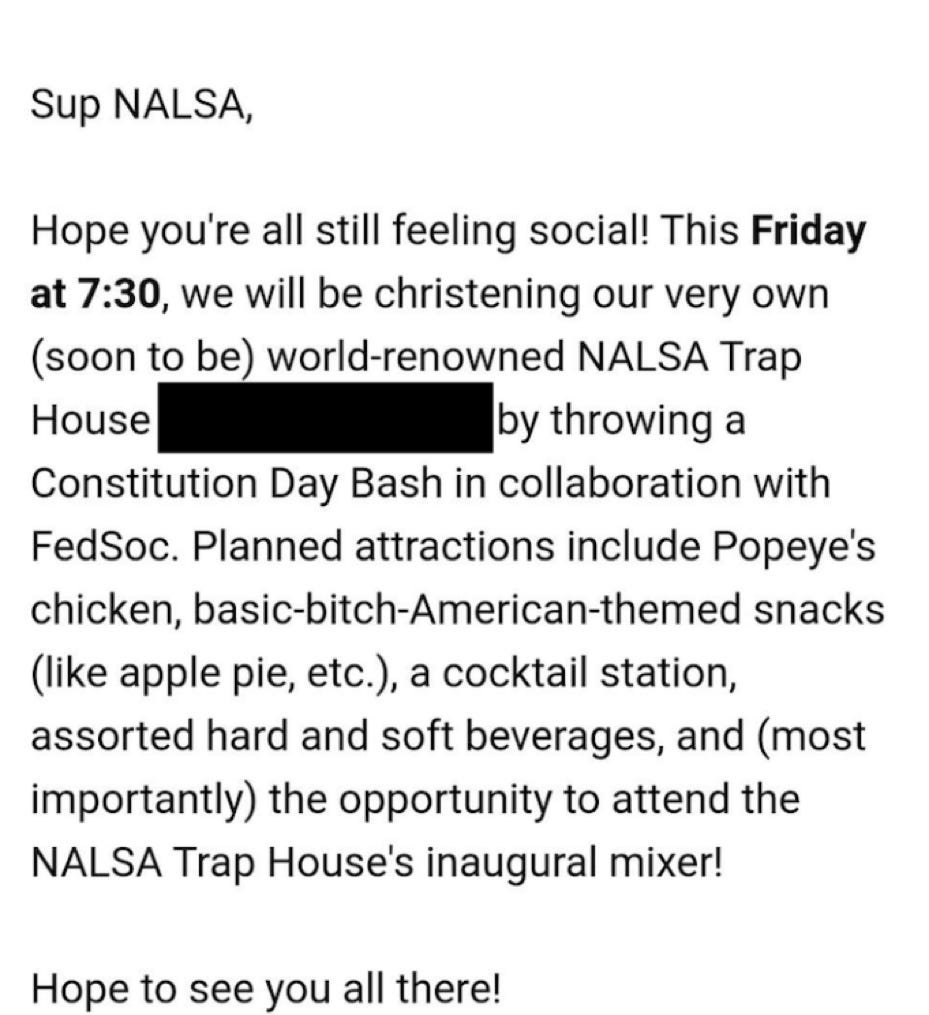
The problems began last month when I sent the following email inviting fellow members of the Native American Law Students Association to a party co-hosted with the Federalist Society, a conservative and libertarian student organization.
Within minutes, someone sent a screenshot of my email to a class-wide forum where several students denounced the message as racist. In no time, people were calling for an apology.
At first, I was unsure what I was being asked to apologize for. I became even more baffled when I was told that my use of the term trap house indicated inherently anti-Black sentiment. As a Gen-Zer, I ve always known trap house to be synonymous with party house. The top entry for traphouse on Urban Dictionary matches exactly what I meant Originally used to describe a crack house in a shady neighborhood, the word has since been abused by high school students who like to pretend they re cool by drinking their mom s beer together and saying they re part of a traphouse.
The popular understanding of traphouse in no way suggests it is a racial slur. If the usage of the term alone is offensive, why have the hosts of Chapo Trap House, the incredibly popular podcast which self-identifies as radically left-wing, not been asked to apologize for the same reason?
Barely twelve hours after I sent the invitation, two discrimination and harassment resource coordinators from the Law School s Office of Student Affairs scheduled a meeting with me. In that discussion, Ellen Cosgrove, the Associate Dean, and Yaseen Eldik, the Director of Diversity, Equity & Inclusion, repeatedly urged me to issue a public apology.
I told them I did not want to send out a generic statement and would rather have individual conversations with anybody offended. I was told that things might escalate if I failed to apologize. I was told that an apology would be more likely to make the situation go away, and it was implied that there would be lingering impacts to my reputation because the legal community is a small one. The subtext behind the meetings that followed became increasingly clear: Apologize or risk the consequences.